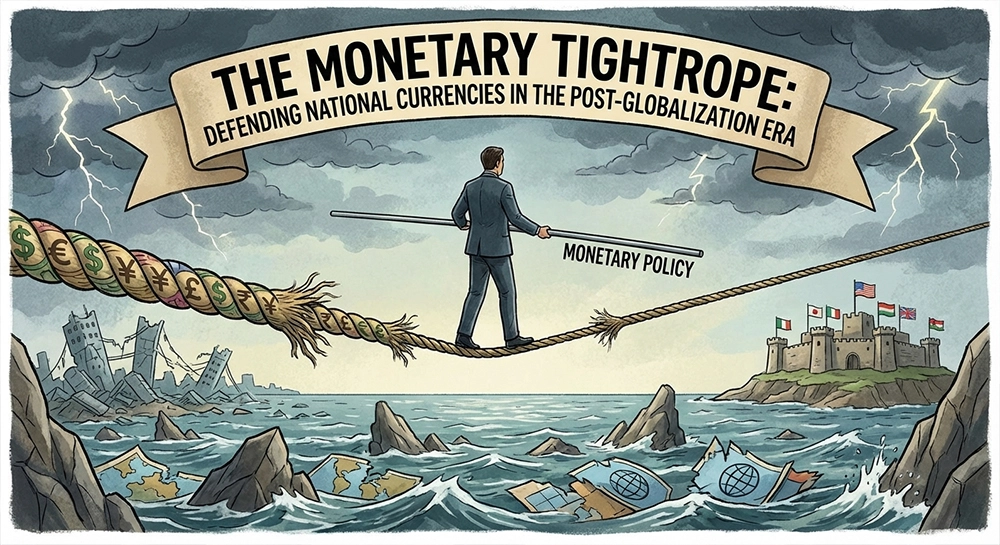
Executive Summary: In 2026, the era of synchronized global monetary policy is a thing of the past. Central banks worldwide are forced to balance on a razor's edge between stimulating domestic industrial growth and preventing uncontrollable devaluation. Amidst trade wars and the formation of new economic blocs, currency stability has become more than just an economic indicator—it is now a critical tool of national security.
The Macro Pivot: From Inflation Targeting to "Managed Flexibility"
For decades, the gold standard for central banks was strict inflation targeting (usually around 2%). However, in 2026, this approach has undergone a radical transformation. As global supply chains fracture into regional blocs, external shocks have become a permanent factor of risk.
Most regulators have shifted to a regime of "Managed Flexibility." This means that central banks allow the national currency to fluctuate within wider bands to absorb external shocks, but they intervene aggressively when volatility threatens financial stability. This approach allows them to maintain export competitiveness without exhausting foreign exchange reserves in futile attempts to defend an "artificial" exchange rate.
The Micro Impact: Hedging as the New Corporate Norm
For the corporate sector, this new reality signals the end of the era of cheap and predictable currency exchange.
Rising Cost of Financial Instruments: The cost of currency forwards and options has surged by 30–40% compared to the start of the decade. Companies are forced to bake these costs directly into their product pricing.
Localization of Settlements: In 2026, we are witnessing a rapid development of bilateral clearing systems. Large multinational corporations are increasingly settling trades in the national currencies of regional blocs (e.g., within Asian or Latin American trade unions) to minimize reliance on the US Dollar.
Central Bank Digital Currencies (CBDCs): The implementation of wholesale CBDCs allows banks to conduct cross-border payments instantly, significantly reducing liquidity risks during sharp exchange rate fluctuations.
Risk Assessment: The Devaluation Spiral and Sovereign Debt
The primary danger in 2026 remains the "Devaluation Trap." If a central bank allows its currency to weaken too significantly to support the export sector, it automatically increases the cost of servicing external debt denominated in hard currencies.
In 2026, this risk is exacerbated by high levels of global debt. The world financial system is facing the phenomenon of "Imported Inflation": as a currency falls, critical imports (energy, technology) become more expensive. This forces central banks to raise interest rates once again, stifling economic growth in the process.
Investor Outlook: Searching for "Fiscal Fortresses"
In a world of volatile currencies, investment capital in 2026 is gravitating toward countries that possess:
A Positive Trade Balance: Countries that export more than they import have a natural defense for their currency.
Technological Autonomy: States that are less dependent on importing critical technologies can withstand exchange rate fluctuations more easily.
High Foreign Exchange Reserves: A significant "cushion" remains the primary psychological anchor for investors.
Conclusion: Monetary policy in 2026 is not about statics, but about dynamic survival. Central banks have become the lead players on the geopolitical chessboard, where every decision regarding an interest rate or an intervention has a direct impact on a country's position in the new world order.